Full review of the PSVR version of rhythm action game Synth Riders from Kluge Interactive.
Let me just say right now, if you’re a fan of well-produced rhythm games, or you’re just here to find out if this is a good PSVR conversion, then stop this video right now and go buy Synth Riders. It is awesome and you will not be disappointed. I could leave it there and make this the shortest review ever but in case some of you are still hanging on for more details then let me give you the lowdown.
I must say thanks to the developer Kluge Interactive for providing me with a review key for the game, but as always the opinions here are entirely my own.
Synth Riders, for anyone who somehow doesn’t already know, is a rhythm action game that’s been available on PC and Quest for some time and has received great reviews and a huge following, and deservedly so. Although it has some obvious similarities to that other king of VR rhythm games Beat Saber, it’s certainly not an imitation, and in fact the two games both originally came out at around the same time in 2018.
Rather than slicing blocks, in Synth Riders you hold two coloured orbs which you use to hit notes, in the form of other orbs, as they fly towards you in time with the music. With the default colour scheme, pink and blue notes have to be touched with the appropriate hand, orange notes have to be touched with both hands together, and green notes can be touched with either hand but whichever hand you use first you should continue to use until the end of the section. Sometimes the notes appear along twisting rails which you have to trace with your hand from beginning to end. While it may feel less impactful than slicing blocks, all of this combined creates much more of a natural dancing motion whereas Beat Saber tends to make you look more like you’re trying to swat flies.
There are also two styles of play, either Rhythm or Force. With the Rhythm style you earn more points for accuracy and hitting as close as possible to the center of each note. With the Force style you’re rewarded for hitting the notes harder, in more of a punching motion, which can really give you quite an extreme workout.
This is all easy to pick up and learn and several tutorials are provided in case you’re in any doubt. Once into the game proper you can choose from a variety of songs and difficulty levels, ranging from Easy to Master. As with most rhythm games, while the Easy setting acts as a good intro you’ll soon find yourself bumping up the difficulty, but rest assured once you go beyond Normal the challenge quickly ramps up.
For me, the most important aspect of a rhythm game is that the mapping and interaction has to feel tightly synchronised with the music. Although that may sound obvious I’ve played plenty of wannabee rhythm games which only felt partially in time with the music or where the mapping didn’t bear any resemblance to the music whatsoever. It’s here that Synth Riders gets things just right and is top of the class with Beat Saber and Audica in that regard.
You’ll find a huge amount of options and modifiers to get the game set up just how you like it, so many in fact that I’ll most likely go into more detail in another video. Chances are that if you can think of an option you’d like to tweak then it’s probably provided here.
One modifier in particular that changes things up is the Spin mode. When this is on the notes will be coming at you from within a range of 90 degrees around you, rather than always being directly in front of you, requiring you to turn to your left and right at various points during the levels. On the original PC and Quest versions this was actually a 360 degree mode but understandably that had to be restricted for PSVR due to the camera tracking limitations.
Another feature I absolutely love is that you can create playlists and choose to play them non-stop in one continuous session, with no pauses between tracks. This was something I always wanted from Beat Saber, which offers a playlist function but stops and starts in between each track, taking you out of the action each time.
So what about the music itself? Well, the base game provides over 50 tracks out of the box, with optional DLC music packs providing around 25 more. Although predominantly electronic, there’s a decent variety of synthwave, dubstep, punk, metal and even electroswing, and some big name artists such as Muse and The Offspring. Hopefully the artists and genres will continue to expand with future DLC as well, but even the base selection will keep most people busy for a while.
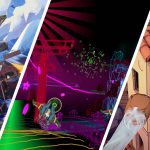
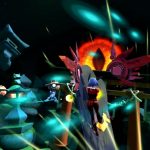
Graphics for the game are nice and sharp with a heavily vaporwave-influenced palette. There’s a good range of moving and static stages to choose from, some with cool features like a giant head that mimics your own head movements. For anyone who suffers from motion sickness, or those who just don’t want to be distracted, there’s an option to turn off some of the movement. Although the stages are all generally of a good standard, some are better than others, and a couple of them look a little muddy or dull by comparison. This is a minor complaint though as you’re usually too busy to notice the background anyway!
A few songs, three at launch, have so-called Experiences available with them, which are more bespoke stages designed specifically to complement the music. High scores aren’t counted for these so they’re just for fun, but they do make a nice change from the regular stages, and I hope to see more of them added.
Sadly, the online multiplayer will be missing from the launch version but the devs have said they’re still working on it and hope to release it as an update in the near future. There is however a party mode for those who want to play local multiplayer.
As you can probably tell I love this game and I’m pleased to say that the devs have done a great job with bringing it to PSVR. Like I said at the start, if you like rhythm games then you shouldn’t hesitate to pick this one up immediately.
The base game is available now for £20. Tracks can be bought individually for £1.69 each, or in packs for around £6 or £7, but if you want the whole lot then you can buy an all-inclusive edition, featuring the base game and all DLC, for £45 or the bargain price of £36 for PS Plus subscribers until the 23rd August.